ENT Specialist / Otolaryngologist: Complete Guide to Ear, Nose and Throat Health
Learn what an ENT Specialist or Otolaryngologist treats, when you should see one, common ear, nose and throat conditions, diagnostic tests, treatment options and when urgent medical attention may be needed.
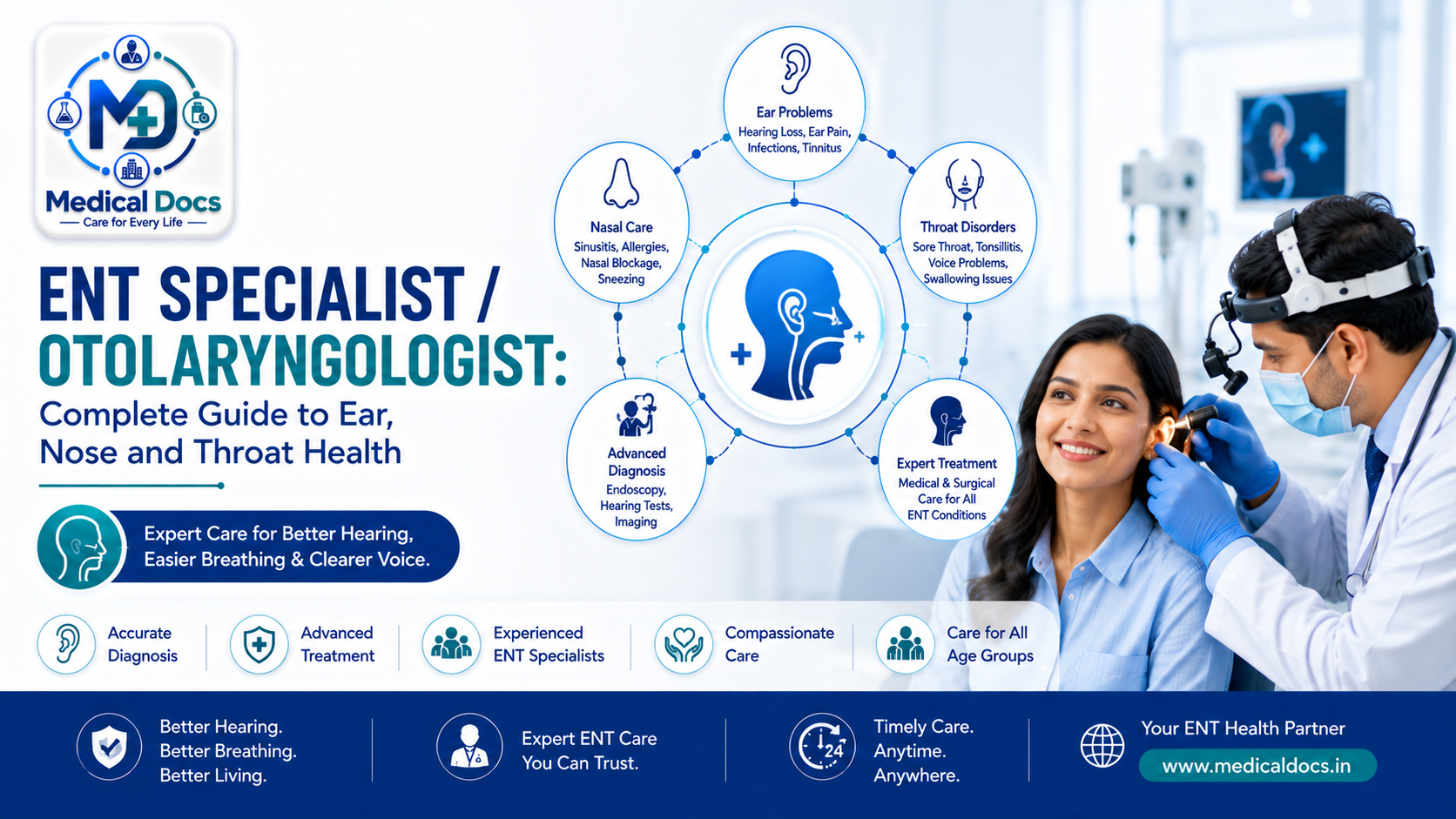
Your ears help you hear and maintain balance. Your nose allows you to breathe and smell. Your throat plays an important role in speaking, swallowing and breathing.
When something goes wrong with any of these areas, the symptoms can quickly become part of everyday life.
A blocked nose that does not go away, repeated sinus infections, difficulty hearing conversations, persistent throat pain, frequent tonsillitis, loud snoring or recurring dizziness may all require professional evaluation.
This is where an ENT Specialist, medically known as an Otolaryngologist, can help.
An ENT Specialist is a medical doctor who diagnoses and treats conditions affecting the ear, nose, throat, head and neck. ENT care includes both medical and surgical treatment, depending on the condition.
Medical Docs – India’s Most Trusted Healthcare Single Window Platform helps patients discover doctors and healthcare services through a connected digital healthcare ecosystem.
What Is an ENT Specialist?
ENT Specialist stands for Ear, Nose and Throat Specialist.
The medical name for this specialty is Otolaryngology – Head and Neck Surgery.
ENT Specialists manage a wide range of conditions involving:
- Ears
- Nose
- Sinuses
- Throat
- Voice box
- Hearing
- Balance
- Tonsils and adenoids
- Head and neck structures
They treat patients of all ages, from infants and children to adults and older people.
Depending on their area of expertise, some ENT Specialists may have additional experience in fields such as:
- Pediatric ENT
- Rhinology and sinus disorders
- Otology and neurotology
- Hearing and balance disorders
- Voice and swallowing disorders
- Head and neck surgery
- Sleep-related breathing disorders
The American Academy of Otolaryngology–Head and Neck Surgery describes otolaryngologists as physicians trained in the medical and surgical management of conditions involving the ear, nose, throat and related head and neck structures.
Why Do People Visit an ENT Specialist?
ENT problems can range from a temporary infection to conditions that require long-term treatment.
A person may seek an ENT consultation because of:
- Ear problems — hearing loss, ear pain, infections or ringing in the ears.
- Nose problems — persistent congestion, sinus symptoms, allergies or difficulty breathing through the nose.
- Throat problems — recurring sore throat, tonsillitis, swallowing difficulties or voice changes.
- Sleep problems — loud snoring or suspected obstructive sleep apnea.
- Balance problems — dizziness or vertigo.
The important thing is not simply treating the symptom.
The goal is to identify the underlying cause.
Ear Problems an ENT Specialist Treats
The ear is responsible for both hearing and balance.
Problems affecting the ear can therefore influence communication, concentration, work and overall quality of life.
Ear Infections
Ear infections can occur in children and adults.
Symptoms may include:
- Ear pain
- Feeling of pressure
- Reduced hearing
- Fluid or discharge
- Fever
- Irritability in children
Treatment depends on the type and cause of the infection.
Repeated ear infections may require further evaluation.
Hearing Loss
Hearing loss can develop gradually or occur suddenly.
A person with gradual hearing loss may not immediately realize that their hearing has changed.
Common signs include:
- Frequently asking others to repeat themselves
- Increasing the television volume
- Difficulty understanding speech in noisy places
- Feeling that people are mumbling
- Missing phone conversations
- Difficulty following group conversations
Hearing loss can occur because of ageing, noise exposure, ear disease, certain medications, infections, injury and other causes.
An ENT Specialist can evaluate the possible cause and may coordinate hearing tests with an Audiologist.
Tinnitus: Ringing or Noise in the Ear
Tinnitus refers to hearing sounds such as:
- Ringing
- Buzzing
- Hissing
- Whistling
- Clicking
when there is no external source producing the sound.
Tinnitus can occur temporarily or persist for longer periods.
It may be associated with hearing loss, noise exposure, ear conditions or other factors.
Persistent tinnitus should be evaluated, particularly if it is one-sided, pulsatile or accompanied by hearing loss, dizziness or neurological symptoms.
Earwax and Blocked Ears
Earwax is normal and helps protect the ear canal.
However, excessive accumulation can sometimes cause:
- Hearing reduction
- Ear fullness
- Discomfort
- Ringing
- Changes in hearing
One important rule is to avoid putting cotton buds or other objects deep inside the ear.
They can push wax further into the ear canal or injure the ear.
If earwax is causing symptoms, an ENT Specialist can examine the ear and remove impacted wax safely when necessary.
Vertigo and Balance Problems
Vertigo is the sensation that you or your surroundings are moving or spinning.
It can sometimes originate from problems involving the inner ear, which plays an important role in balance.
Possible symptoms include:
- Spinning sensation
- Unsteadiness
- Nausea
- Vomiting
- Difficulty walking
- Ear fullness
- Hearing changes
Conditions such as Benign Paroxysmal Positional Vertigo (BPPV), Ménière's disease and other vestibular disorders may require specialist evaluation.
However, dizziness can also have neurological, cardiovascular or other causes.
A proper diagnosis is therefore important.
Nose and Sinus Problems
The nose is more than an organ of smell.
It filters, warms and humidifies the air we breathe.
When nasal passages become inflamed or blocked, breathing can become uncomfortable.
Sinusitis
Sinusitis occurs when the tissues lining the sinuses become inflamed.
Symptoms can include:
- Nasal congestion
- Facial pressure
- Thick nasal discharge
- Reduced sense of smell
- Headache
- Cough
- Difficulty breathing through the nose
Some sinus problems are short-term, while chronic sinusitis can persist for a longer period.
An ENT Specialist can evaluate recurring or persistent symptoms and determine whether medical treatment, further investigation or another approach is appropriate.
Allergic Rhinitis
Allergic rhinitis occurs when the immune system reacts to allergens such as pollen, dust mites, mould or animal dander.
Symptoms may include:
- Sneezing
- Runny nose
- Nasal congestion
- Itchy nose
- Watery eyes
An ENT Specialist may help evaluate persistent nasal symptoms and work with other specialists when necessary.
Deviated Nasal Septum
The nasal septum separates the two sides of the nose.
When the septum is significantly displaced, it may contribute to:
- Difficulty breathing through the nose
- Nasal congestion
- Recurrent sinus symptoms
- Snoring
- Nosebleeds in some cases
Not every deviated septum requires treatment.
If symptoms are significant, an ENT Specialist can assess whether medical management or surgery may be appropriate.
Nasal Polyps
Nasal polyps are soft, non-cancerous growths that can develop inside the nose or sinuses.
They may cause:
- Nasal blockage
- Reduced sense of smell
- Runny nose
- Postnasal drip
- Facial pressure
Treatment depends on the severity and underlying cause.
Some patients may require medication, while others with persistent or severe disease may be considered for procedures or surgery.
Throat Problems
Your throat is involved in breathing, swallowing and communication.
Persistent throat symptoms should not always be dismissed as a simple infection.
Tonsillitis
Tonsils are part of the body's immune system.
Tonsillitis occurs when the tonsils become inflamed, often due to infection.
Symptoms may include:
- Sore throat
- Difficulty swallowing
- Fever
- Swollen tonsils
- Enlarged lymph nodes
- Bad breath
Repeated or severe tonsillitis may require an ENT evaluation.
In selected cases, tonsillectomy may be considered.
Enlarged Adenoids in Children
Adenoids are tissue located behind the nose.
In children, enlarged adenoids can sometimes contribute to:
- Nasal breathing difficulty
- Mouth breathing
- Snoring
- Sleep disturbance
- Recurrent ear problems
- Changes in speech or voice
An ENT Specialist can assess whether enlarged adenoids are contributing to a child's symptoms.
Persistent Sore Throat
Most sore throats are temporary and caused by infections or irritation.
But a sore throat that persists, repeatedly returns or is accompanied by other concerning symptoms may need medical evaluation.
Persistent symptoms can have several possible causes, including:
- Chronic irritation
- Acid reflux
- Allergies
- Infection
- Voice overuse
- Other throat conditions
An ENT examination can help identify the underlying problem.
Voice and Speech Problems
Your voice is produced through a complex interaction between the lungs, vocal cords, throat and nervous system.
Persistent hoarseness or voice changes may be associated with:
- Vocal strain
- Infections
- Acid reflux
- Vocal cord disorders
- Smoking
- Other conditions
If hoarseness persists for several weeks, particularly in a smoker or someone with other risk factors, professional evaluation is important.
ENT Specialists can examine the larynx and vocal cords using specialized instruments when required.
Difficulty Swallowing
Difficulty swallowing is medically known as dysphagia.
It may involve difficulty moving food or liquids from the mouth through the throat.
Symptoms can include:
- Food feeling stuck
- Coughing while eating
- Choking
- Pain while swallowing
- Repeated throat clearing
- Unexplained weight loss
Swallowing difficulties should not be ignored, particularly when they persist or worsen.
An ENT Specialist may evaluate the throat and coordinate additional testing with other healthcare professionals when necessary.
Snoring and Sleep-Related Breathing Problems
Snoring is common, but loud or persistent snoring can sometimes be associated with obstructive sleep apnea.
Warning signs may include:
- Loud habitual snoring
- Pauses in breathing during sleep
- Gasping or choking at night
- Excessive daytime sleepiness
- Morning headaches
- Difficulty concentrating
- Poor-quality sleep
An ENT Specialist may evaluate anatomical factors contributing to airway obstruction and, where appropriate, work with sleep specialists and other healthcare professionals.
Head and Neck Conditions
ENT specialists also manage conditions involving parts of the head and neck.
These can include:
- Neck lumps
- Salivary gland disorders
- Thyroid-related surgical conditions in some ENT practices
- Head and neck infections
- Certain benign growths
- Head and neck cancers
A new or persistent lump in the neck should be professionally evaluated rather than assumed to be harmless.
When Should You See an ENT Specialist?
Consider an ENT consultation if you have:
- Persistent ear pain
- Recurrent ear infections
- Hearing difficulties
- Persistent ringing in the ears
- Recurrent dizziness or vertigo
- Chronic nasal congestion
- Repeated sinus problems
- Difficulty breathing through the nose
- Recurrent tonsillitis
- Persistent sore throat
- Long-lasting hoarseness
- Difficulty swallowing
- Loud or persistent snoring
- Recurrent nosebleeds
- A persistent lump in the neck
Early evaluation can be particularly useful when symptoms keep returning or interfere with normal life.
ENT Symptoms That Need Urgent Medical Attention
Some symptoms should not wait for a routine appointment.
Seek urgent medical attention if there is:
- Sudden hearing loss
- Severe breathing difficulty
- Severe difficulty swallowing with inability to handle saliva
- Significant bleeding
- Serious facial or neck injury
- Severe swelling affecting breathing
- Sudden neurological symptoms associated with dizziness
- Rapidly worsening symptoms after an injury
Sudden hearing loss, particularly when it develops rapidly, should be treated as a medical urgency and assessed promptly.
If there is a life-threatening emergency in India, call 112 or go to the nearest emergency medical facility.
What Happens During an ENT Consultation?
An ENT consultation usually begins with a detailed discussion about your symptoms.
The doctor may ask about:
- When symptoms started
- How frequently they occur
- Previous infections
- Hearing changes
- Allergies
- Medications
- Previous surgeries
- Smoking or tobacco exposure
- Sleep quality
- Voice changes
- Swallowing difficulties
The physical examination may involve the:
- Ear canal
- Eardrum
- Nose
- Sinuses
- Mouth
- Throat
- Neck
Depending on the symptoms, additional tests may be recommended.
Common Tests Used by ENT Specialists
Hearing Test
Audiological testing can assess the type and degree of hearing loss.
Nasal Endoscopy
A small specialized instrument can allow the ENT Specialist to examine deeper areas of the nasal passages and throat.
Tympanometry
This test evaluates the movement of the eardrum and middle-ear function.
Imaging
CT or MRI may be recommended for selected sinus, ear, head or neck conditions.
Sleep Study
A sleep study may be recommended when obstructive sleep apnea or another sleep disorder is suspected.
Balance Testing
Specialized vestibular testing may be used when certain balance disorders are suspected.
The appropriate test depends on the patient's symptoms and clinical examination.
Can an ENT Specialist Perform Surgery?
Yes.
ENT Specialists are trained in both medical and surgical management of conditions affecting the ear, nose, throat, head and neck.
Depending on their area of specialization, procedures may include:
- Tonsillectomy
- Adenoidectomy
- Sinus surgery
- Septoplasty
- Ear surgery
- Tympanoplasty
- Procedures for nasal obstruction
- Head and neck procedures
- Certain procedures for sleep-related breathing disorders
Surgery is considered only when clinically appropriate.
Many ENT conditions can be managed without an operation.
ENT Care for Children
Children frequently experience ENT-related problems.
Common concerns include:
- Recurrent ear infections
- Enlarged tonsils
- Enlarged adenoids
- Hearing difficulties
- Speech and language concerns
- Nasal breathing problems
- Snoring
- Recurrent throat infections
Because hearing and breathing can influence a child's development, persistent symptoms deserve appropriate evaluation.
A Pediatric ENT Specialist has specific experience in treating ear, nose and throat conditions in children.
Protecting Your Ear, Nose and Throat Health
Good ENT care is not only about treatment.
Daily habits can also help protect these important systems.
Protect Your Hearing
Avoid prolonged exposure to loud sounds and use appropriate hearing protection in noisy environments.
Avoid Putting Objects Inside Your Ears
Cotton buds and other objects can damage the ear canal or eardrum.
Manage Allergies
If allergies trigger persistent nasal symptoms, appropriate medical management can help reduce discomfort.
Stay Hydrated
Adequate hydration supports normal mucus production and overall health.
Avoid Smoking and Tobacco
Smoking and tobacco exposure can significantly affect the respiratory tract and increase the risk of several head and neck diseases.
Do Not Ignore Persistent Voice Changes
Long-lasting hoarseness should be medically evaluated.
Treat Recurrent Symptoms Properly
Repeated ear, sinus or throat problems may have an underlying cause that requires specialist assessment.
ENT Specialist vs Audiologist
These professionals often work together but have different roles.
An ENT Specialist is a medical doctor who diagnoses and treats diseases of the ear, nose, throat, head and neck.
An Audiologist specializes in evaluating hearing and balance and may provide hearing-related rehabilitation and hearing devices according to their professional scope.
For example:
- Ear disease or sudden hearing change → ENT Specialist
- Detailed hearing assessment → Audiologist
Depending on the condition, both may be involved in a patient's care.
ENT Specialist vs General Physician
A General Physician can evaluate many common conditions, including uncomplicated infections and general health problems.
An ENT Specialist has specialized training in disorders involving the ear, nose, throat, head and neck.
A General Physician may refer a patient to an ENT Specialist when:
- Symptoms are persistent
- Infections keep recurring
- Hearing is affected
- Surgery may be required
- Specialized examination is needed
- Symptoms involve complex ear, nose or throat conditions
The two specialties can work together for comprehensive care.
How to Choose the Right ENT Specialist
The right ENT doctor depends on your specific healthcare needs.
Consider:
Qualifications and Experience
Check the doctor's medical qualifications and ENT specialization.
Area of Expertise
Some ENT Specialists focus more on:
- Ear and hearing disorders
- Sinus and nasal problems
- Pediatric ENT
- Voice and swallowing
- Sleep medicine
- Head and neck surgery
Diagnostic Facilities
Access to hearing tests, endoscopy and other investigations can be useful depending on your condition.
Hospital and Surgical Facilities
If a procedure is required, appropriate hospital support and postoperative care are important.
Clear Communication
Your doctor should explain the likely cause of your symptoms, available treatment options and expected follow-up.
Find an ENT Specialist Through Medical Docs
Finding the right ENT Specialist can be challenging when doctors, clinics, hospitals, diagnostic centres and pharmacies are available across different platforms.
Medical Docs – India’s Most Trusted Healthcare Single Window Platform is designed to connect patients with healthcare providers through one digital healthcare ecosystem.
Patients can explore doctors and healthcare services based on their requirements.
Find an ENT Specialist on Medical Docs
Medical Docs brings together:
Patients → Doctors → Clinics → Hospitals → Diagnostic Laboratories → Pharmacies
This single-window approach is designed to make healthcare discovery more connected and organized.
A Connected ENT Healthcare Journey
ENT care may involve multiple healthcare professionals and services.
A patient's journey could look like:
ENT Consultation → Examination → Hearing/Diagnostic Testing → Diagnosis → Treatment → Pharmacy → Follow-Up
For certain conditions, the journey may also include:
ENT Specialist → Hospital → Surgery → Rehabilitation → Follow-Up Care
For hearing-related conditions, an Audiologist may also become part of the healthcare team.
A connected healthcare ecosystem can make it easier for patients to discover the different services they may need.
Through Medical Docs, patients can explore doctors, clinics, hospitals, diagnostic laboratories and pharmacies.
Your ENT Health Affects More Than You Think
Hearing loss can affect communication.
Chronic nasal obstruction can affect breathing and sleep.
Persistent throat problems can affect eating and speaking.
Balance disorders can affect confidence and mobility.
Sleep-related breathing problems can affect daytime energy and concentration.
That is why ENT care is not simply about treating an ear infection or clearing a blocked nose.
It is about protecting functions that influence everyday quality of life.
Frequently Asked Questions About ENT Specialists
What does ENT stand for?
ENT stands for Ear, Nose and Throat. The medical specialty is called Otolaryngology.
What does an ENT Specialist treat?
ENT Specialists diagnose and treat conditions affecting the ears, nose, sinuses, throat, voice box, hearing, balance and related head and neck structures.
When should I see an ENT Specialist?
You should consider an ENT consultation for persistent or recurring ear infections, hearing problems, tinnitus, sinus symptoms, nasal blockage, throat problems, voice changes, swallowing difficulties, vertigo or persistent snoring.
Can an ENT Specialist treat hearing loss?
Yes. An ENT Specialist can evaluate hearing loss and determine whether it may be caused by an ear condition or another medical problem. Hearing tests may also be performed by an Audiologist.
Is sudden hearing loss an emergency?
Sudden hearing loss can be a medical urgency and should be evaluated promptly, particularly when it develops rapidly or affects one ear.
Can an ENT Specialist treat sinus problems?
Yes. ENT Specialists commonly diagnose and manage sinus conditions, including chronic or recurrent sinus problems.
Does every sinus problem require surgery?
No. Many sinus conditions can be treated medically. Surgery may be considered in selected cases when symptoms persist despite appropriate treatment or when structural problems require correction.
Can ENT Specialists treat snoring?
Yes. ENT Specialists can evaluate anatomical and airway-related factors that may contribute to snoring and sleep-related breathing problems.
Can children see an ENT Specialist?
Yes. Children commonly receive ENT care for ear infections, enlarged tonsils or adenoids, hearing problems, nasal obstruction and other ENT conditions.
What is the difference between an ENT Specialist and an Audiologist?
An ENT Specialist is a medical doctor who treats diseases of the ear, nose and throat and related head and neck conditions. An Audiologist specializes primarily in hearing and balance assessment and rehabilitation.
Can I find an ENT Specialist online?
Yes. You can explore ENT Specialists and other healthcare providers through Medical Docs.
Conclusion
The ears, nose and throat are closely connected to some of the most important functions of everyday life—including hearing, breathing, balance, swallowing and communication.
Persistent ear pain, hearing changes, tinnitus, recurring sinus problems, nasal blockage, throat infections, voice changes, swallowing difficulties, dizziness or loud snoring should not always be dismissed as minor problems.
An ENT Specialist / Otolaryngologist can evaluate these symptoms, identify possible underlying causes and recommend appropriate medical, rehabilitative or surgical treatment when required.
Good ENT care is not always about surgery.
In many cases, the right diagnosis, timely medical treatment and appropriate follow-up may be enough to manage the problem effectively.
Medical Docs – India’s Most Trusted Healthcare Single Window Platform is designed to connect patients with doctors, clinics, hospitals, diagnostic laboratories and pharmacies through one connected healthcare ecosystem.
Find the right ENT Specialist and explore healthcare services with Medical Docs.
Medical Disclaimer
This article is intended for general educational and informational purposes only. It does not provide a diagnosis or replace consultation with a qualified ENT Specialist, Audiologist, General Physician or other healthcare professional. ENT symptoms can have many different causes and require individual assessment. Do not use antibiotics, ear drops or other prescription medicines without appropriate medical advice. Sudden hearing loss, severe breathing difficulty, significant bleeding, serious injury or other emergency symptoms require prompt medical attention.
Medical information notice
This article is for education only and does not replace diagnosis, treatment or advice from a qualified healthcare professional. Seek urgent care for emergency symptoms.