Medical Docs – India’s Most Trusted Healthcare Single Window Platform
Digital healthcare, connected health records, doctors, clinics, hospitals, diagnostic laboratories and pharmacies ko ek connected healthcare ecosystem mein bring karne ke Medical Docs ke vision ka overview.
Healthcare is one of the most important parts of our lives, yet managing healthcare information and services can often feel fragmented. A patient may visit one doctor for consultation, another facility for diagnostic tests, a pharmacy for medicines, and a hospital for further treatment. Medical reports may remain in email inboxes, prescriptions may be stored as photographs, and important medical documents can easily become difficult to find when they are needed most.
This is where digital healthcare is creating a new opportunity.
Medical Docs – India’s Most Trusted Healthcare Single Window Platform is built around a simple idea: healthcare should be more connected, organized and patient-centric.
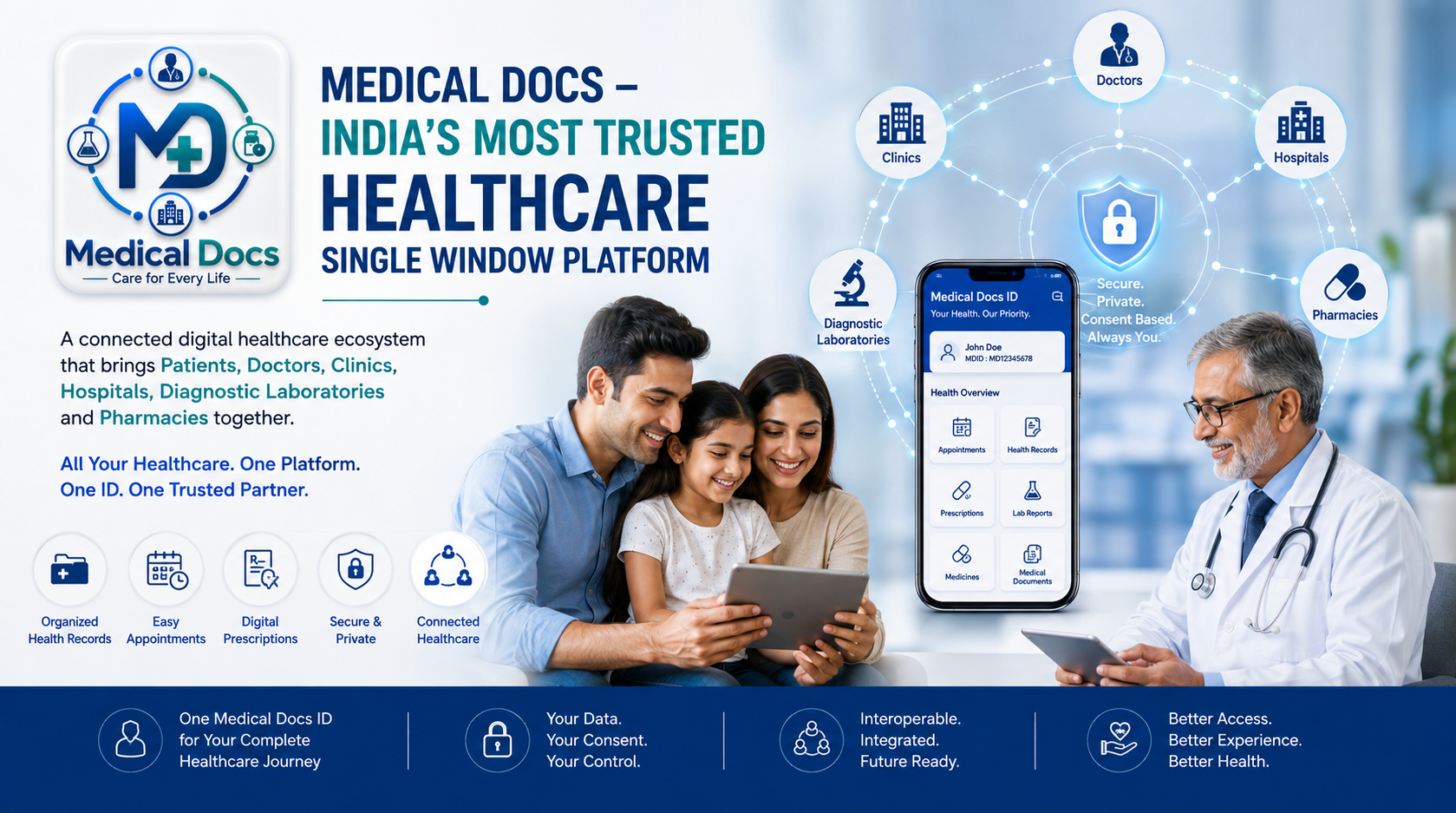
Medical Docs brings important parts of the healthcare journey together through a connected digital ecosystem, helping patients manage their healthcare information while connecting them with doctors, clinics, hospitals, diagnostic laboratories and pharmacies.
The Changing Healthcare Landscape in India
India's healthcare system is large and diverse. People access healthcare through government hospitals, private hospitals, clinics, independent doctors, diagnostic laboratories, pharmacies and numerous other healthcare providers.
While this gives patients many choices, it can also create a fragmented healthcare experience.
A patient might have:
- Consultation records with one doctor
- Diagnostic reports from another laboratory
- Prescriptions from different healthcare providers
- Medicine purchases from different pharmacies
- Hospital documents from previous treatments
- Medical documents saved across phones, emails and physical files
The challenge is not necessarily the lack of healthcare information. The challenge is having the right information organized and available at the right time.
Digital health can help address this challenge. The World Health Organization recognizes digital technologies as an important part of modern healthcare and highlights the importance of interoperability, data sharing and digital solutions that support informed decision-making.
What Is Digital Healthcare?
Digital healthcare refers to the use of digital technologies to support healthcare delivery, health information management and interaction between patients and healthcare providers.
It can include digital medical records, online appointments, teleconsultations, electronic prescriptions, diagnostic reports, health applications, digital health identities and systems that enable healthcare information to move between connected participants.
The objective is not simply to replace paper with screens.
The larger objective is to make healthcare information more accessible, organized, connected and useful, while maintaining appropriate privacy and consent.
Why Connected Healthcare Matters
Healthcare is not a single event.
A patient's healthcare journey can continue for years.
It may begin with a consultation, followed by diagnostic testing, a prescription, medication, follow-up consultation and sometimes hospitalization or specialist care.
When these activities remain disconnected, patients may have difficulty presenting their complete healthcare history to the next provider.
Connected healthcare takes a different approach.
Instead of treating every appointment, report and prescription as a separate event, it creates a more continuous view of the patient's healthcare journey.
Medical Docs follows this approach by bringing records, consultations, laboratory reports, prescriptions and medicine requests together under a unique Medical Docs ID.
Medical Docs: A Single Window for the Healthcare Journey
Medical Docs – India’s Most Trusted Healthcare Single Window Platform is designed to connect different parts of healthcare through one digital ecosystem.
For patients, this can mean having a clearer view of their healthcare information and access to relevant healthcare services from one platform.
The Medical Docs ecosystem connects:
Patients → Doctors → Clinics → Hospitals → Diagnostic Laboratories → Pharmacies
This connected approach can help reduce the need to manage healthcare through multiple disconnected sources.
Medical Docs provides access to healthcare discovery, appointments, health records and other connected-care capabilities through its platform.
Patients can also explore healthcare providers through the Find Care section of the platform.
One Medical Identity for a More Organized Healthcare Journey
One of the central ideas behind Medical Docs is the Medical Docs ID.
Instead of keeping healthcare information scattered across different places, patients can organize consultations, reports, prescriptions and uploaded documents under their unique Medical Docs ID.
This creates a more structured healthcare timeline.
For example:
Doctor Consultation → Diagnostic Test → Laboratory Report → Prescription → Medicine → Follow-up
When these healthcare interactions are organized within a connected system, patients can have a clearer understanding of what happened previously before moving to the next step in their healthcare journey.
Patient Control and Consent
Healthcare information is highly personal. Therefore, digital healthcare cannot be built only around convenience. It must also consider privacy, control and consent.
Medical Docs is designed around the principle that patients should remain informed and in control of access to their health information.
The platform highlights consent before access and OTP-based approval with access history, allowing patients to understand when their information is being accessed.
This principle is also consistent with the direction of India's digital health ecosystem.
According to the official Ayushman Bharat Digital Mission information, health records can be linked and shared with healthcare providers based on the individual's consent. ABDM also states that health records are not centrally stored by ABDM itself; rather, the mission facilitates secure exchange between intended stakeholders after patient consent.
This distinction is important.
Digital healthcare should not mean giving everyone unrestricted access to personal medical information.
It should mean creating systems where information can be accessed and shared appropriately, securely and with the patient's knowledge and consent.
How Digital Medical Records Can Help Patients
Maintaining organized medical records can be useful throughout a person's healthcare journey.
1. Better Organization
Patients can find important health information more easily instead of searching through physical files, phone galleries, emails or multiple applications.
2. Better Continuity of Care
When previous consultations, reports and prescriptions are available in an organized format, healthcare providers can have better context when evaluating a patient's ongoing care.
3. Easier Access to Medical History
Previous medical information can become particularly important during follow-up consultations, specialist visits and long-term treatment.
4. Reduced Dependence on Paper
Digital records can reduce the need to carry large collections of physical reports and prescriptions.
5. More Informed Healthcare Conversations
Having relevant health information available can help patients communicate more clearly with healthcare providers about their previous consultations, investigations and treatments.
These benefits depend on the quality, accuracy, availability and appropriate use of digital health information. Digital records are a tool to support healthcare—not a replacement for professional medical judgment.
Connecting Doctors, Hospitals, Clinics and Laboratories
A truly connected healthcare platform cannot focus only on patients.
Healthcare providers are equally important.
Doctors need access to relevant patient information.
Hospitals and clinics need efficient ways to manage patient interactions.
Diagnostic laboratories generate reports that can become important parts of a patient's medical history.
Pharmacies play an important role after a prescription is issued.
A connected ecosystem can bring these different participants closer together.
Medical Docs provides dedicated pathways for patients as well as healthcare providers, including doctors, clinics, hospitals, diagnostic laboratories and pharmacies.
Healthcare providers can also explore the Medical Docs provider platform to build a trusted profile and participate in connected care.
The Role of Diagnostic Laboratories in Connected Healthcare
Diagnostic testing is often a critical part of healthcare decision-making.
Blood tests, imaging, pathology reports and other diagnostic investigations can generate information that patients may need months or years later.
When diagnostic information is properly organized with the patient's healthcare journey, it becomes easier to understand the sequence of consultations, investigations and follow-ups.
Medical Docs includes diagnostic laboratories within its connected healthcare ecosystem, helping bring laboratory services closer to the broader patient journey.
Patients can explore Diagnostic Laboratories through Medical Docs.
Connecting Healthcare and Pharmacy Services
The healthcare journey does not end when a doctor writes a prescription.
Patients may then need to find medicines, compare available options, locate pharmacies and manage medicine-related requirements.
Medical Docs brings pharmacies into the same broader healthcare ecosystem.
This creates an opportunity to connect the journey:
Consultation → Prescription → Medicine Request → Pharmacy
The objective is to make healthcare more connected instead of requiring patients to navigate every stage independently.
Patients can explore Verified Pharmacies through the platform.
India's Digital Health Ecosystem Is Evolving
The development of digital healthcare in India is also supported by national digital-health initiatives.
The Ayushman Bharat Digital Mission aims to create a digital health ecosystem and provides mechanisms for creating and managing ABHA, discovering and linking health records, viewing records and sharing them with healthcare providers through consent-based mechanisms.
The official ABDM information explains that the ABHA Number is intended to uniquely identify individuals and help thread their health records across multiple systems and stakeholders with informed patient consent.
This demonstrates an important direction for healthcare in India:
Healthcare is moving toward greater connectivity and interoperability.
Medical Docs operates within this broader movement toward more organized and digitally connected healthcare, with its own focus on bringing healthcare interactions together through a patient-centered platform.
What Does the Future of Healthcare Look Like?
The future of healthcare will not be defined only by hospitals, medicines or medical devices.
It will increasingly depend on how effectively information moves between patients and healthcare providers.
The future healthcare experience could involve:
- More connected digital health records
- Easier healthcare discovery
- Better interoperability between systems
- More convenient appointment management
- Secure digital information exchange
- Greater patient participation
- Consent-based access to health information
- More connected relationships between doctors, facilities, laboratories and pharmacies
WHO also identifies interoperability and data sharing as important components of digital health systems.
The ultimate goal should remain simple:
Better access to the right healthcare information at the right time, while keeping patients informed and in control.
Why Medical Docs Is Building a Single Window Healthcare Platform
The healthcare industry has many specialized services, but patients experience healthcare as one continuous journey.
They do not think of their health history as separate databases.
They think about:
- **My doctor.
- My reports.
- My prescriptions.
- My medicines.
- My hospital.
- My health history.**
Medical Docs is built around this patient perspective.
By bringing patients, doctors, clinics, hospitals, diagnostic laboratories and pharmacies into one connected ecosystem, Medical Docs aims to make healthcare easier to navigate and more organized.
Its platform focuses on a clear principle:
Connected care, with consent.
That means healthcare information should be useful, accessible and connected—while the patient remains at the center of the journey.
Conclusion
Digital healthcare is changing how people discover, access and manage healthcare services.
But the real opportunity is bigger than simply putting healthcare services online.
The next generation of healthcare will be about connection—connecting patients with doctors, doctors with relevant patient information, laboratories with healthcare journeys, pharmacies with prescriptions and different healthcare interactions into a more understandable timeline.
Medical Docs – India’s Most Trusted Healthcare Single Window Platform is built with this vision: to bring the healthcare journey together through one connected digital ecosystem.
From finding healthcare providers and booking appointments to organizing health records, consultations, laboratory reports and prescriptions, Medical Docs aims to give patients a more connected way to manage their healthcare.
Because healthcare should not feel like a collection of disconnected appointments.
Your health journey should remain connected.
Frequently Asked Questions
What is a digital healthcare platform?
A digital healthcare platform is an online system that connects patients with healthcare services and can support activities such as provider discovery, appointments, health records and healthcare information management.
What is Medical Docs?
Medical Docs is a digital healthcare platform designed to connect patients with doctors, clinics, hospitals, diagnostic laboratories and pharmacies while helping organize important healthcare interactions and records.
What is a Medical Docs ID?
A Medical Docs ID is a unique identity used within the Medical Docs platform to organize consultations, reports, prescriptions and uploaded healthcare documents.
What is connected healthcare?
Connected healthcare refers to an approach where patients, healthcare providers, medical information and healthcare services can work together through connected digital systems.
Are digital medical records important?
Yes. Organized digital records can make it easier to access previous health information and share relevant information with healthcare providers when appropriate.
Can patients control access to their health information?
Consent-based access is an important principle in modern digital healthcare. India's ABDM framework, for example, provides mechanisms for patients to control sharing of their health records through consent.
Can Medical Docs help me find healthcare providers?
Yes. Medical Docs provides healthcare discovery options for doctors, clinics, hospitals, diagnostic laboratories and pharmacies.
Is Medical Docs an emergency medical service?
No. Medical Docs is not an emergency service. In India, call 112 or visit the nearest emergency department for a medical emergency.
Explore Medical Docs
Medical Docs – India’s Most Trusted Healthcare Single Window Platform
Medical information notice
This article is for education only and does not replace diagnosis, treatment or advice from a qualified healthcare professional. Seek urgent care for emergency symptoms.