Orthopedic Doctor: Your Guide to Bone, Joint, Muscle and Spine Health
Learn what an Orthopedic Doctor treats, common bone, joint, muscle and spine conditions, when to seek orthopedic care, available treatments, diagnostic tests and ways to protect musculoskeletal health.
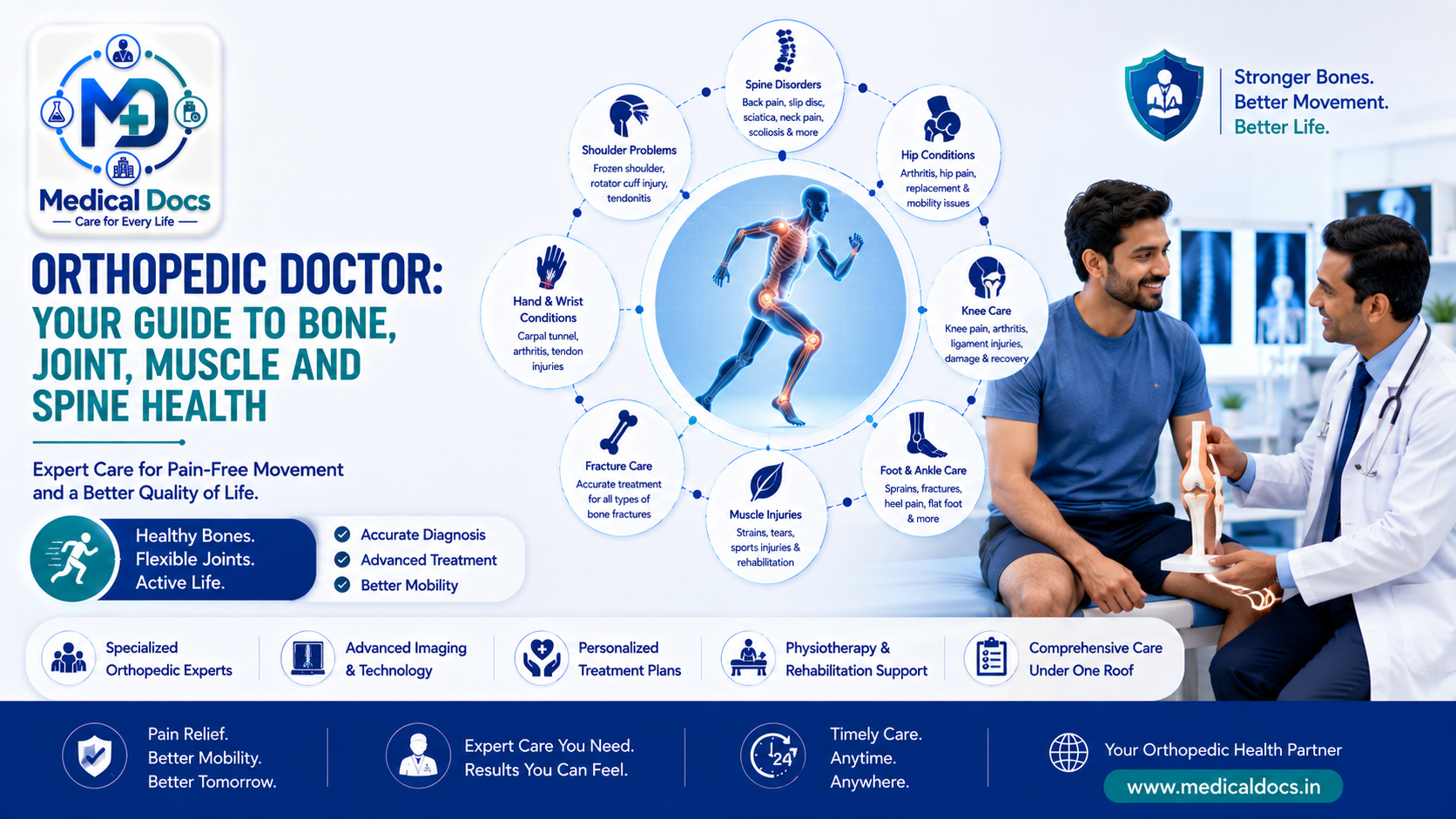
A healthy musculoskeletal system allows you to walk, work, exercise, lift objects, maintain balance and perform everyday activities without unnecessary pain.
But when a knee starts hurting while climbing stairs, a shoulder becomes difficult to move, back pain keeps returning, or an injury affects your ability to walk, the problem may involve more than temporary discomfort.
This is where an Orthopedic Doctor can help.
Orthopedic Doctors specialize in conditions affecting the bones, joints, muscles, ligaments, tendons and other parts of the musculoskeletal system. They diagnose injuries and diseases, provide non-surgical treatment when appropriate and may perform surgery when it is medically necessary.
Medical Docs – India’s Most Trusted Healthcare Single Window Platform helps patients discover doctors and healthcare services through a connected digital healthcare ecosystem.
What Is an Orthopedic Doctor?
An Orthopedic Doctor, also called an Orthopedist or Orthopedic Surgeon, is a medical specialist who diagnoses and treats conditions affecting the musculoskeletal system.
Despite the term "Orthopedic Surgeon," not every orthopedic problem requires surgery.
Orthopedic care can involve:
- Physical examination
- Medication
- Activity modification
- Physiotherapy
- Rehabilitation
- Braces or supports
- Injections in selected cases
- Fracture management
- Minimally invasive procedures
- Orthopedic surgery when necessary
The American Academy of Orthopaedic Surgeons explains that orthopaedic surgeons specialize in the prevention, diagnosis and treatment of disorders involving the musculoskeletal system.
What Does an Orthopedic Doctor Treat?
Orthopedics covers a broad range of problems, from sudden sports injuries to long-term joint conditions.
Some of the most common reasons patients consult an Orthopedic Doctor include:
Fractures and Broken Bones
A fracture occurs when a bone partially or completely breaks.
Fractures can result from:
- Falls
- Road accidents
- Sports injuries
- Workplace injuries
- Direct impact
- Weakened bones
Treatment depends on the type, location and severity of the fracture.
Some fractures can be treated with immobilization, while others may require surgical fixation.
Arthritis and Joint Problems
Arthritis can cause pain, stiffness and reduced movement.
It can affect:
- Knees
- Hips
- Shoulders
- Hands
- Feet
- Spine
- Other joints
Osteoarthritis is particularly common with increasing age, although joint problems can occur for many different reasons.
An Orthopedic Doctor can assess the affected joint and determine an appropriate treatment strategy.
Knee Pain: One of the Most Common Orthopedic Complaints
Knee pain can affect people of almost any age.
Possible causes include:
- Arthritis
- Ligament injuries
- Meniscus injuries
- Sports injuries
- Tendon problems
- Overuse
- Fractures
- Muscle weakness
Not every knee pain requires an operation.
Treatment depends on the underlying cause and may involve exercise, physiotherapy, medication, activity modification, injections or surgery when appropriate.
If knee pain is persistent, worsening or interfering with walking and daily activities, an orthopedic evaluation may be useful.
Back Pain and Spine Problems
Back pain is extremely common.
In many cases, it improves with appropriate conservative care.
However, persistent or severe back pain may sometimes be associated with conditions involving the spine, discs or nerves.
Orthopedic specialists with expertise in spine care may evaluate conditions such as:
- Disc problems
- Spinal arthritis
- Spinal deformities
- Certain spinal injuries
- Nerve compression
- Some forms of chronic back pain
Back pain accompanied by significant weakness, loss of bladder or bowel control, numbness in the saddle area or other serious neurological symptoms requires urgent medical evaluation.
Shoulder Pain and Limited Movement
Shoulder problems can make ordinary activities difficult.
You may notice pain while:
- Raising your arm
- Reaching overhead
- Sleeping on the affected side
- Dressing
- Lifting objects
Possible causes include:
- Rotator cuff injuries
- Tendon problems
- Shoulder instability
- Arthritis
- Frozen shoulder
- Fractures
An Orthopedic Doctor can evaluate the shoulder and determine whether imaging or other investigations are required.
Sports Injuries
You do not have to be a professional athlete to experience a sports injury.
Common injuries include:
- Sprains
- Muscle strains
- Ligament injuries
- Tendon injuries
- Dislocations
- Fractures
- Meniscus injuries
Athletes may require a structured rehabilitation plan to return safely to their sport.
The goal is not simply to reduce pain.
It is also to restore strength, movement, stability and function.
Ligament and Tendon Injuries
Ligaments connect bones to other bones, while tendons connect muscles to bones.
Injuries involving these structures can occur during sports, falls or sudden movements.
Common examples include:
- ACL injuries
- MCL injuries
- Achilles tendon injuries
- Rotator cuff injuries
- Ankle ligament sprains
Treatment depends on the severity of the injury, the patient's activity level and other individual factors.
Some injuries can recover with rehabilitation, while others may require surgical treatment.
Osteoporosis and Bone Health
Bones are living tissue.
With age, bone strength can decrease, increasing the risk of fractures.
Osteoporosis is a condition characterized by reduced bone strength and an increased risk of fractures.
People may not know they have osteoporosis until a fracture occurs.
Risk assessment and bone-health evaluation can therefore be important for people with relevant risk factors.
An Orthopedic Doctor may work with other healthcare professionals to evaluate bone health and manage fractures associated with weakened bones.
When Should You See an Orthopedic Doctor?
You may want to consult an Orthopedic Doctor if you experience:
- Persistent joint pain
- Repeated back pain
- Difficulty walking
- Joint stiffness
- Reduced range of movement
- Swelling around a joint
- Repeated sports injuries
- Persistent muscle or tendon pain
- Suspected fracture
- Joint instability
- Pain that interferes with sleep or daily activities
- Recovery problems after an injury
You should not assume that severe or recurring pain is simply a normal part of ageing.
Persistent symptoms deserve proper evaluation.
When Is an Orthopedic Injury an Emergency?
Some injuries require immediate medical attention.
Seek urgent medical care after a serious injury if there is:
- Severe pain
- Obvious deformity
- Inability to use or bear weight on a limb
- Significant swelling
- Loss of sensation
- A limb that appears pale, blue or unusually cold
- Heavy bleeding
- An open fracture
- Severe injury following a road accident or major fall
A suspected fracture or serious trauma should be evaluated promptly.
In an emergency in India, 112 is the national emergency number.
Does Every Orthopedic Problem Require Surgery?
No.
This is one of the most important things patients should understand about orthopedic care.
Depending on the diagnosis, treatment may include:
Rest and activity modification
Reducing activities that aggravate the condition may help certain injuries recover.
Physiotherapy
Structured exercises can help restore strength, flexibility, balance and movement.
Medication
Pain-relieving or anti-inflammatory medicines may be recommended when appropriate.
Braces and Supports
Some injuries or joint conditions may benefit from temporary support.
Injections
Certain joint or soft-tissue conditions may be treated with injections when clinically appropriate.
Surgery
Surgery is considered when conservative treatment is unlikely to provide adequate results or when the nature of the injury or disease requires an operation.
The right treatment depends on the individual diagnosis.
What Happens During an Orthopedic Consultation?
An orthopedic consultation generally begins with a discussion about your symptoms and medical history.
The doctor may ask:
- When did the pain begin?
- Was there an injury?
- What activities make it worse?
- Is the pain constant or intermittent?
- Is there swelling?
- Can you move the affected joint normally?
- Have you tried any treatment?
- Do you have previous injuries or surgeries?
- Are you taking any medications?
The Orthopedic Doctor may then examine:
- Strength
- Joint movement
- Stability
- Swelling
- Tenderness
- Walking pattern
- Muscle function
Depending on the suspected problem, the doctor may recommend imaging or other tests.
Common Tests Used in Orthopedic Care
The appropriate investigation depends on the symptoms and clinical examination.
X-Ray
X-rays are commonly used to evaluate bones and can help identify many fractures and certain joint changes.
MRI
MRI provides detailed images of soft tissues and can help evaluate structures such as ligaments, tendons, muscles and discs.
CT Scan
CT imaging can provide detailed views of bones and is particularly useful for certain complex injuries.
Bone Density Testing
Bone mineral density testing can help assess bone strength and is commonly used when osteoporosis is suspected or screening is appropriate.
Blood Tests
Blood tests may sometimes be useful when an inflammatory, metabolic or other systemic cause of musculoskeletal symptoms is being considered.
Orthopedic Doctor vs Physiotherapist
These professionals have different roles and often work together.
An Orthopedic Doctor is a medical doctor who diagnoses and treats musculoskeletal conditions and can perform surgery when necessary.
A Physiotherapist specializes in rehabilitation, movement, exercise and physical techniques that help restore function.
For example:
Diagnosis of ligament injury → Orthopedic Doctor
Post-injury rehabilitation → Physiotherapist
Many patients may benefit from both.
Orthopedic Doctor vs Rheumatologist
The two specialties can sometimes overlap because both may treat joint-related symptoms.
An Orthopedic Doctor primarily focuses on musculoskeletal injuries, structural problems and conditions that may require orthopedic intervention.
A Rheumatologist specializes in diseases involving the immune system, joints, muscles and connective tissues, including inflammatory conditions such as rheumatoid arthritis.
The appropriate specialist depends on the suspected cause of the symptoms.
Orthopedic Care for Children
Children have developing bones and joints, and their orthopedic needs can differ from those of adults.
Some children may experience:
- Sports injuries
- Fractures
- Growth-related problems
- Differences in limb alignment
- Congenital musculoskeletal conditions
- Walking abnormalities
A Pediatric Orthopedic Specialist has additional expertise in musculoskeletal conditions affecting children.
Parents should seek professional evaluation when a child has persistent pain, abnormal walking, repeated injuries or noticeable changes in movement or limb alignment.
Joint Replacement: When Is It Considered?
Joint replacement is a surgical procedure in which a damaged joint is replaced with an artificial joint.
It is most commonly associated with severely damaged hip or knee joints.
However, joint replacement is not automatically the first treatment for joint pain.
It may be considered when:
- Joint damage is significant
- Pain is persistent
- Daily activities are substantially affected
- Non-surgical treatment is no longer providing sufficient relief
- The patient is medically suitable for surgery
The decision should be made after a detailed assessment between the patient and orthopedic specialist.
How to Protect Your Bones and Joints
Orthopedic health is not only about treating injuries.
Everyday habits can also support musculoskeletal health.
Stay Physically Active
Regular movement helps maintain strength, flexibility and functional capacity.
Build Muscle Strength
Appropriate strength training can support joints and improve overall physical function.
Maintain a Healthy Weight
Excess body weight can increase mechanical stress on weight-bearing joints such as the knees and hips.
Use Proper Technique During Exercise
Correct form can reduce unnecessary strain and injury risk.
Wear Appropriate Protective Equipment
Sports-specific protective equipment can reduce the risk of certain injuries.
Maintain Bone-Healthy Nutrition
Adequate nutrition, including calcium and vitamin D when appropriate, supports bone health.
Do Not Ignore Persistent Pain
Pain that repeatedly returns or interferes with normal activity deserves evaluation rather than indefinite self-treatment.
Choosing the Right Orthopedic Doctor
Finding an orthopedic specialist should involve more than selecting the closest clinic.
Consider:
Relevant Qualifications
Check the doctor's medical qualification and orthopedic specialization.
Experience With Your Condition
An Orthopedic Doctor may have particular expertise in areas such as:
- Knee
- Hip
- Shoulder
- Spine
- Sports injuries
- Trauma
- Joint replacement
- Pediatric orthopedics
Hospital and Diagnostic Facilities
If surgery or advanced investigations become necessary, access to appropriate facilities can be useful.
Clear Communication
Your doctor should explain the diagnosis, treatment options and expected recovery in understandable language.
Rehabilitation and Follow-Up
Recovery does not always end when pain decreases. Physiotherapy and follow-up may be important after certain injuries and procedures.
Find an Orthopedic Doctor Through Medical Docs
Finding a suitable orthopedic specialist can be difficult when information about doctors, clinics, hospitals and diagnostic services is spread across different platforms.
Medical Docs – India’s Most Trusted Healthcare Single Window Platform is designed to connect patients with healthcare providers through one connected digital ecosystem.
Patients can explore doctors and healthcare services based on their needs.
Find an Orthopedic Doctor on Medical Docs
Medical Docs brings together:
Patients → Doctors → Clinics → Hospitals → Diagnostic Laboratories → Pharmacies
This single-window approach is designed to make healthcare discovery more connected and organized.
A Complete Orthopedic Care Journey
Musculoskeletal treatment can involve several stages.
A patient's journey may look like:
Orthopedic Consultation → Diagnostic Imaging → Diagnosis → Treatment → Physiotherapy → Rehabilitation → Follow-Up
For an injury, the process may involve an Orthopedic Doctor and Physiotherapist.
For a surgical condition, the patient may also require hospital services, diagnostic support and pharmacy services.
Medical Docs is designed to connect these different parts of the healthcare ecosystem.
Through Medical Docs, patients can explore doctors, clinics, hospitals, diagnostic laboratories and pharmacies.
Why You Should Not Ignore Persistent Musculoskeletal Pain
Pain is often the body's way of telling you that something needs attention.
A minor injury may improve with time.
But pain that continues for weeks, repeatedly returns, affects sleep or limits everyday activities may need a proper medical assessment.
Getting the cause identified can help answer important questions:
Is it an injury?
Is there joint damage?
Is the pain related to a muscle or tendon?
Could it be arthritis?
Does the condition require physiotherapy?
Is imaging necessary?
Could surgery actually be required?
The answer depends on the individual patient—not simply on the location of the pain.
Frequently Asked Questions About Orthopedic Doctors
What does an Orthopedic Doctor treat?
Orthopedic Doctors diagnose and treat conditions affecting bones, joints, muscles, ligaments, tendons and other parts of the musculoskeletal system.
Should I see an Orthopedic Doctor for back pain?
Persistent, severe or recurring back pain may require medical evaluation. An Orthopedic Doctor, particularly one specializing in spine conditions, may be appropriate depending on the symptoms.
Does every fracture require surgery?
No. Many fractures can be treated without surgery, while certain fractures require surgical fixation. Treatment depends on the type, location and severity of the fracture.
Can an Orthopedic Doctor treat arthritis?
Yes. Orthopedic Doctors commonly evaluate and treat several types of joint arthritis and related musculoskeletal problems.
When should I see an Orthopedic Doctor for knee pain?
Consider an orthopedic consultation if knee pain is persistent, worsening, associated with swelling or instability, or interfering with walking, exercise, sleep or daily activities.
Can Orthopedic Doctors treat sports injuries?
Yes. Orthopedic specialists can diagnose and treat many sports injuries, including ligament injuries, fractures, tendon problems and joint injuries.
What is the difference between an Orthopedic Doctor and a Physiotherapist?
An Orthopedic Doctor diagnoses and medically manages musculoskeletal conditions and can perform surgery when needed. A Physiotherapist focuses primarily on rehabilitation, movement and restoring physical function.
Can children see an Orthopedic Doctor?
Yes. Children can develop fractures, sports injuries and developmental or congenital musculoskeletal conditions. Pediatric Orthopedic Specialists have additional expertise in children's orthopedic care.
When is joint replacement considered?
Joint replacement may be considered when a joint is significantly damaged, pain is persistent and daily function is substantially affected despite appropriate non-surgical treatment.
Can I find an Orthopedic Doctor online?
Yes. You can explore Orthopedic Doctors and other healthcare providers through Medical Docs.
Conclusion
Your bones, joints, muscles, ligaments and tendons work together every time you walk, sit, run, lift, bend or perform a simple everyday task.
When an injury occurs or persistent pain begins affecting your movement, ignoring the problem may not always be the best approach.
An Orthopedic Doctor can evaluate musculoskeletal problems ranging from fractures and sports injuries to arthritis, ligament damage, joint problems and certain spine conditions.
And orthopedic treatment does not automatically mean surgery.
Depending on the diagnosis, appropriate care may involve medication, physiotherapy, rehabilitation, activity modification, supportive devices, injections or surgery when necessary.
If you are experiencing persistent musculoskeletal pain or recovering from an injury, professional evaluation can help you understand the cause and available treatment options.
Medical Docs – India’s Most Trusted Healthcare Single Window Platform is designed to connect patients with doctors, clinics, hospitals, diagnostic laboratories and pharmacies through one connected digital healthcare ecosystem.
Find the right Orthopedic Doctor and explore healthcare services with Medical Docs.
Medical Disclaimer
This article is intended for general educational and informational purposes only. It does not provide a diagnosis or replace consultation with a qualified Orthopedic Doctor or other healthcare professional. Musculoskeletal pain and injuries can have many different causes and require individual assessment. Do not rely on this article for self-diagnosis or treatment decisions. Serious injuries, suspected fractures, major trauma, loss of sensation or other emergency symptoms require prompt medical attention.
Medical information notice
This article is for education only and does not replace diagnosis, treatment or advice from a qualified healthcare professional. Seek urgent care for emergency symptoms.